SELAH // REFLECTIONS / Original work
The War Within: Meaning of James 4:1 ('Desires That Battle Within You')
Scripture
James 4:1–2
"What causes fights and quarrels among you? Don’t they come from your desires that battle within you? You desire but do not have, so you kill. You covet but you cannot get what you want, so you quarrel and fight. You do not have because you do not ask God." — James 4:1-2
James traces the quarrels among his readers to desires at war within them. His words call us to examine our own unsubmitted desires rather than excuse the conflicts they produce.
The Thorns of Desire
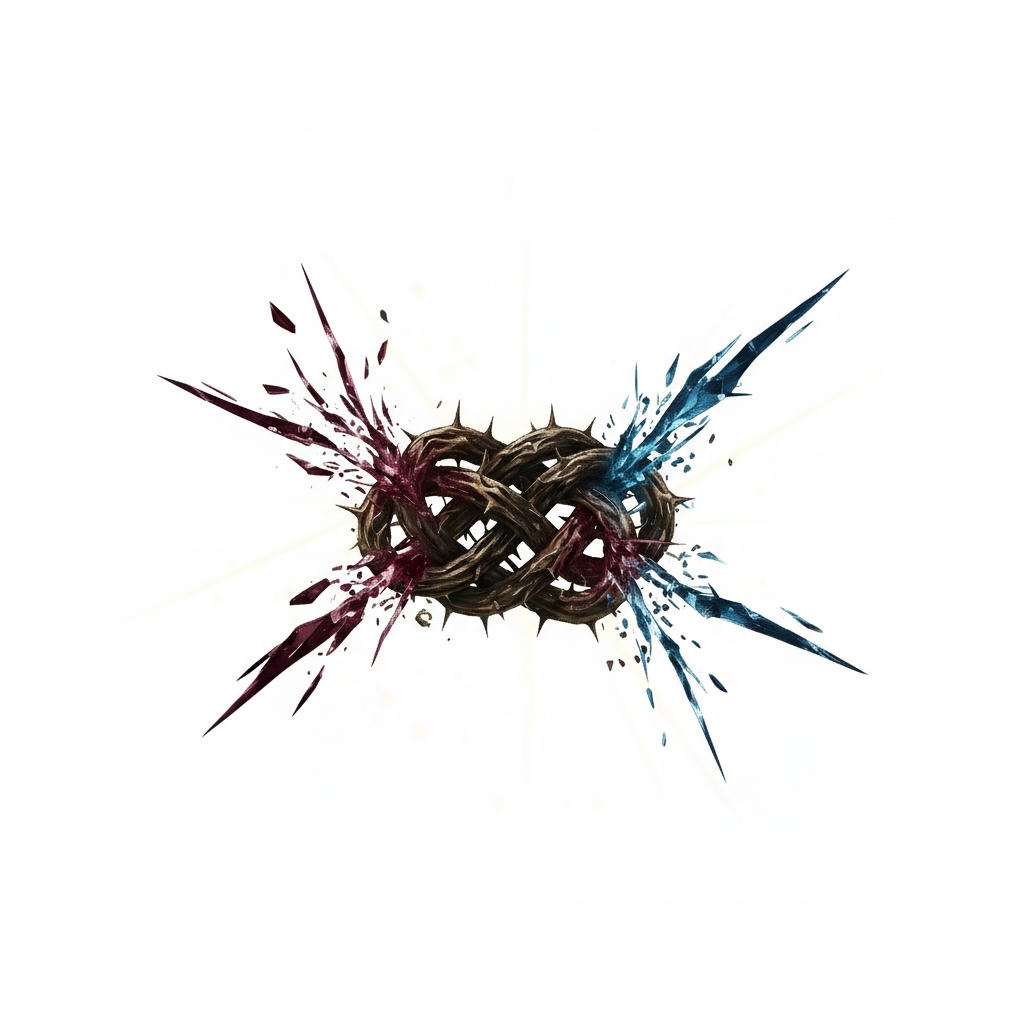
At the center of the design is a tightly interwoven, thorny knot. This represents the "desires that battle within you." Thorns are sharp, painful, and entangling. Our desires, when unsubmitted to God, become like this—they choke out peace, inflict wounds, and create an inescapable snare. The knot illustrates how these desires become intertwined, forming a complex, self-defeating mess that fuels internal unrest.
The Outward Explosion of Conflict
From this central knot, two violent splashes of shattered energy erupt in opposite directions: one red/purple and one blue. This is the visualization of "fights and quarrels." When internal battles are not resolved at the heart level, they inevitably explode outward, causing destruction and division. The sharp, fragmented shards represent the broken relationships, bitter words, and shattered peace that are the direct consequences of coveting and unchecked ambition. The colors clashing symbolize the polarization and division that results.
The Unseen Source of Provision
James offers a solution, quietly nestled within the accusation: "You do not have because you do not ask God." The design, with its light central area, hints at the unseen, unspoken truth: there is a better source. The destructive desires are a symptom of a deeper spiritual void, a failure to approach the true provider. The answer to inner conflict is not merely to suppress desire, but to re-direct it to the benevolent Giver.
This design is a mirror. It forces us to ask: What internal desire is currently battling within you, and what kind of destructive outward explosion is it threatening to cause?