SELAH // REFLECTIONS / Original work
The Incompatibility of Grace: The Meaning of New Wine in Old Wineskins (Luke 5:38)
Scripture
Luke 5:36–39
The Incompatibility of Grace
"And no one pours new wine into old wineskins. If he does, the new wine will burst the skins, the wine will run out and the wineskins will be ruined. No, he pours new wine into new wineskins..." — Luke 5:37–38
Jesus gives these images in response to a question about fasting (Luke 5:33–39). He first compares His presence with a bridegroom’s presence, then speaks of a new garment and new wine requiring fitting containers. The artwork applies these images to receptiveness to Christ’s work; the passage does not simply equate everything old with legalism.
The Futility of the Patch
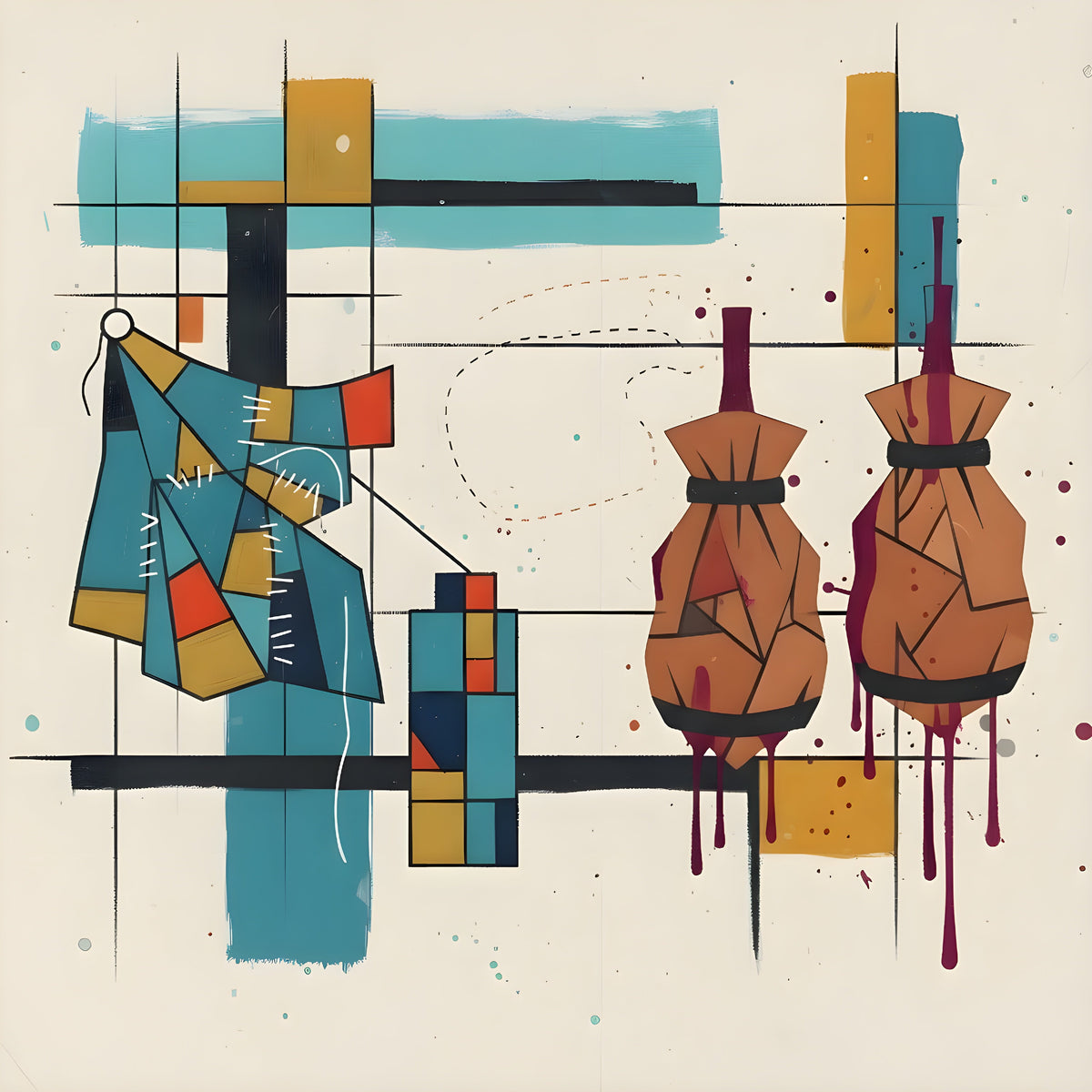
The colorful geometric patch is stitched onto a worn frame. Luke 5:36 describes damage to the new garment and a patch that does not match the old. The artwork uses that mismatch to explore the limits of trying to fit Christ’s work into familiar patterns. Its application to legalism is a reflection, rather than a definition supplied by the verse.
The visible stitching and background grid emphasize the mismatch. Luke’s wording differs from the saying about a worse tear in Matthew 9:16 and Mark 2:21; here the new garment is damaged and its patch does not agree with the old.
The Stress of the New Wine
The wineskins on the right are the ultimate warning. Wineskins, made of animal hide, become rigid and brittle over time. When new wine (which is actively fermenting and expanding) is poured into them, the pressure becomes too great. The sagging, old skins are bursting, and the precious new wine is dripping away in dark, wasted stains.
The artwork uses new wine as a symbol of the life and work of Christ through the Spirit, and the old skin as a picture of resistance. Luke does not directly identify the wine as the Holy Spirit or say that God’s message is rendered powerless by a resistant person. The spilling wine belongs to the parable’s image of unsuitable containers.
The Demand for Total Renewal
The contrast invites openness to what Jesus brings. In Luke 5:39, He also observes the preference for familiar old wine. The design’s expanding vessel turns that tension into a question about readiness to receive Christ, without treating novelty itself as a mark of faithfulness.
The design asks whether our familiar patterns help us receive Christ’s work or resist it. Its patch, wineskins and dark drips give that examination a visual form, while the passage keeps our attention on Jesus and the newness of His presence.
RELATED ARTIFACTS
